Rethinking Student Thinking in an AI World
The conversation is not just about what students produce. It is about how their thinking becomes visible.
April 30, 2026 · Natasha Nurse
A lot of the conversation starts with the tool itself. What can it do? Should students use it? How will teachers know what is really theirs? What happens when an assignment can be completed faster than ever before?
Those are fair questions. I have asked them too.
But lately, the question that stays with me is not only about the tool. It shows up in my classroom, in my doctoral work, and in the professional learning I am building:
What happens to student thinking when AI can make it easier to get to a finished product?
That question matters because AI didn’t create every concern we’re naming in education. In some ways, it is making an old problem harder to ignore. A finished assignment can look complete without showing how a student got there. A response can sound polished while hiding the thinking behind it.
That is the part I do not want us to lose.
The Work Beneath the Product
So much of learning happens before students are ready to show us something finished. It happens when they pause, reread, question an idea, test their thinking, and realize something may need to change.
That work is not always neat. It can be quiet, uneven, and unfinished. But it is often where the real learning lives.
That is where AI has changed the conversation for me. It can shorten the space between a task and a response. Work can be drafted, organized, or polished before we ever see the thinking that led there.
That does not mean every student is trying to avoid learning. It means the path to completion has changed.
And if we only look at the finished work, we may miss the thinking that never had to become visible. We may miss the question a student would have asked, the uncertainty they would have worked through, or the moment where their understanding could have deepened.
I am not interested in pretending AI is not part of the world our students are learning in. It is. Some students are using it. Adults are using it. Schools are trying to figure out what responsible use should look like.
But I also do not think every conversation about AI needs to begin with a new tool.
The stronger starting point is the learning itself.
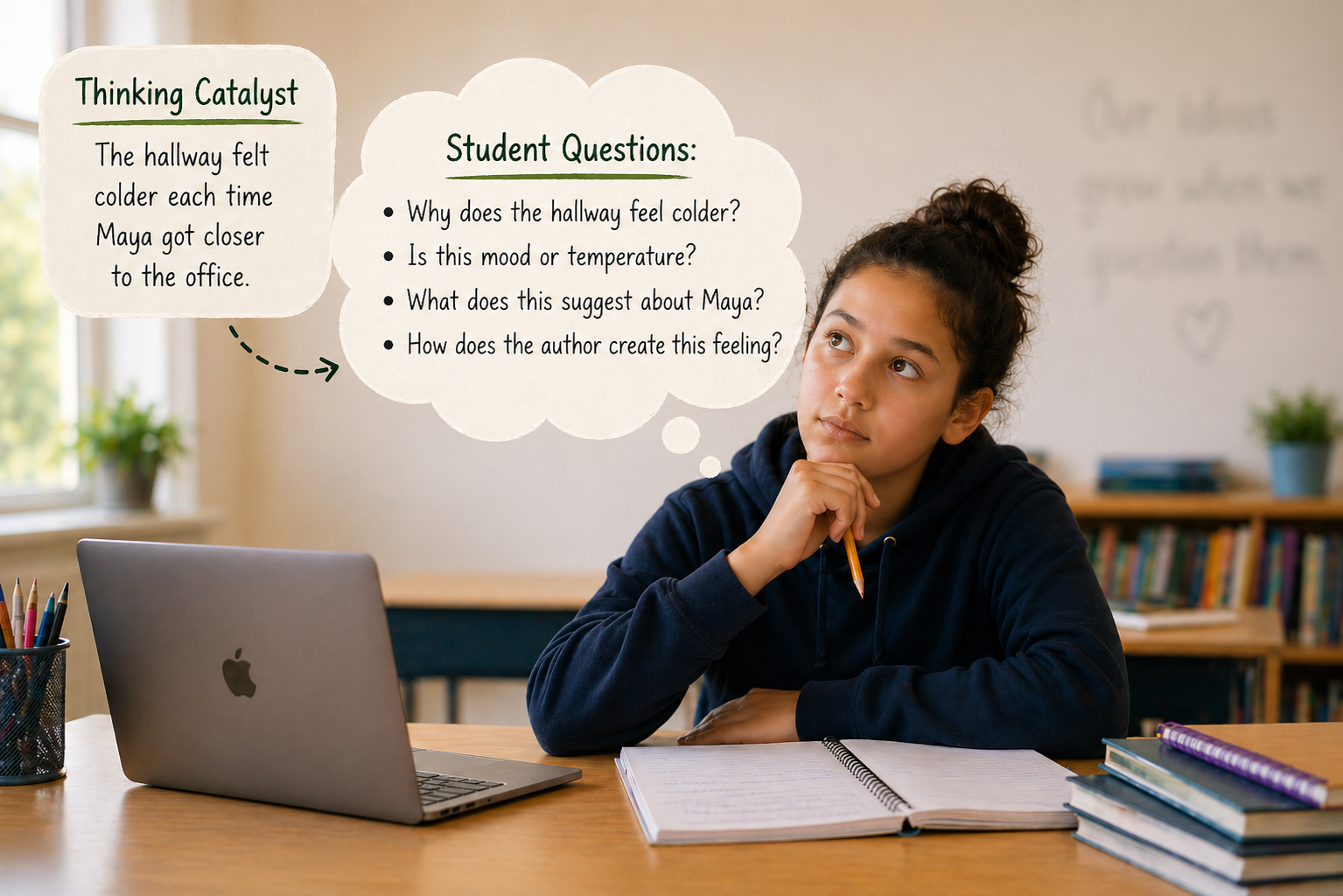
Students need a reason to slow down with the material before the task becomes only about finishing. The point is not to make the work more complicated. The point is to create space for students to form their own questions first.
Those questions matter because they give us a window into how students are entering the work before the answer takes over.
That first layer is worth protecting.
Student First. AI Second. Reflection Always.
The student should not disappear inside the tool. The tool should not become the teacher. The final product should not become the only evidence of learning.
When students begin with their own thinking, AI can become part of a more useful process later on. It can help them look again at an idea, clarify a response, revise a question, or check the strength of their reasoning. But it should not replace the student’s role in making meaning.
The reflection piece is what makes the difference.
Students need space to notice what changed after using AI. Did an idea become clearer? Did a question become stronger? Did they find evidence that supported or challenged their thinking? Did they accept something too quickly because it sounded confident?
That last part matters.
AI can make something sound finished before the thinking is actually finished.
Without reflection, AI use can become invisible. With reflection, it becomes something students can examine and learn from.
What Schools Need as They Navigate AI
As schools begin or continue to shape guidance around AI, clear expectations will matter. Teachers, students, and families need shared language around responsible use, academic integrity, access, and what it means to use these tools in ways that support learning.
At the same time, guidance alone won’t answer every question teachers are facing. A policy can set direction, but it doesn’t always show what this looks like in the daily work of a classroom.
That is where schools have a real opportunity.
Instead of only asking whether students used AI, we can also ask what parts of their thinking we were able to see. Did students have time to ask questions first? Did their reasoning become visible? Did they reflect on what changed?
That does not mean adding more to teachers’ plates.
It means paying closer attention to the work students are already doing and making sure their thinking does not get hidden behind a finished product.
What This Could Look Like in the Classroom
This can start small.
Instead of starting with completion, we can create space for students to engage with the material first. That might come from a line in a text, an image, or a problem that asks them to pause and think.
From there, students can generate their own questions and return to them as the work develops. Even a small shift like this can help teachers see how students are making sense of the work, not just what appears at the end.
Moving Forward
I do not think the future of education will be defined by whether students can generate answers quickly.
They already can.
The more important question is what students learn to do before and after those answers appear. Students still need practice slowing down with an idea, asking stronger questions, connecting thinking to evidence, and recognizing when something still needs to be checked.
That is where our attention needs to go.
AI is not going away, and neither is our responsibility to help students think deeply. If anything, that responsibility is becoming more urgent.
This is the work I am building across my classroom, my writing, and the professional learning I am designing for educators. I am interested in AI, but I am even more interested in what AI is asking us to reconsider about learning itself.
Because in the age of AI, the goal cannot simply be faster completion.
The goal has to be deeper thinking.
Let’s stay connected:
