Rethinking Student Thinking in an AI World
We’re seeing more completed work… but not always more visible thinking. This piece explores what AI is making harder to see in student learning and why that matters for classroom practice.
The conversation is not just about what students produce. It is about how their thinking becomes visible.
April 30, 2026 · Natasha Nurse
A lot of the conversation starts with the tool itself. What can it do? Should students use it? How will teachers know what is really theirs? What happens when an assignment can be completed faster than ever before?
Those are fair questions. I have asked them too.
But lately, the question that stays with me is not only about the tool. It shows up in my classroom, in my doctoral work, and in the professional learning I am building:
What happens to student thinking when AI can make it easier to get to a finished product?
That question matters because AI didn’t create every concern we’re naming in education. In some ways, it is making an old problem harder to ignore. A finished assignment can look complete without showing how a student got there. A response can sound polished while hiding the thinking behind it.
That is the part I do not want us to lose.
The Work Beneath the Product
So much of learning happens before students are ready to show us something finished. It happens when they pause, reread, question an idea, test their thinking, and realize something may need to change.
That work is not always neat. It can be quiet, uneven, and unfinished. But it is often where the real learning lives.
That is where AI has changed the conversation for me. It can shorten the space between a task and a response. Work can be drafted, organized, or polished before we ever see the thinking that led there.
That does not mean every student is trying to avoid learning. It means the path to completion has changed.
And if we only look at the finished work, we may miss the thinking that never had to become visible. We may miss the question a student would have asked, the uncertainty they would have worked through, or the moment where their understanding could have deepened.
I am not interested in pretending AI is not part of the world our students are learning in. It is. Some students are using it. Adults are using it. Schools are trying to figure out what responsible use should look like.
But I also do not think every conversation about AI needs to begin with a new tool.
The stronger starting point is the learning itself.
Students need a reason to slow down with the material before the task becomes only about finishing. The point is not to make the work more complicated. The point is to create space for students to form their own questions first.
Those questions matter because they give us a window into how students are entering the work before the answer takes over.
That first layer is worth protecting.
Student First. AI Second. Reflection Always.
The student should not disappear inside the tool. The tool should not become the teacher. The final product should not become the only evidence of learning.
When students begin with their own thinking, AI can become part of a more useful process later on. It can help them look again at an idea, clarify a response, revise a question, or check the strength of their reasoning. But it should not replace the student’s role in making meaning.
The reflection piece is what makes the difference.
Students need space to notice what changed after using AI. Did an idea become clearer? Did a question become stronger? Did they find evidence that supported or challenged their thinking? Did they accept something too quickly because it sounded confident?
That last part matters.
AI can make something sound finished before the thinking is actually finished.
Without reflection, AI use can become invisible. With reflection, it becomes something students can examine and learn from.
What Schools Need as They Navigate AI
As schools begin or continue to shape guidance around AI, clear expectations will matter. Teachers, students, and families need shared language around responsible use, academic integrity, access, and what it means to use these tools in ways that support learning.
At the same time, guidance alone won’t answer every question teachers are facing. A policy can set direction, but it doesn’t always show what this looks like in the daily work of a classroom.
That is where schools have a real opportunity.
Instead of only asking whether students used AI, we can also ask what parts of their thinking we were able to see. Did students have time to ask questions first? Did their reasoning become visible? Did they reflect on what changed?
That does not mean adding more to teachers’ plates.
It means paying closer attention to the work students are already doing and making sure their thinking does not get hidden behind a finished product.
What This Could Look Like in the Classroom
This can start small.
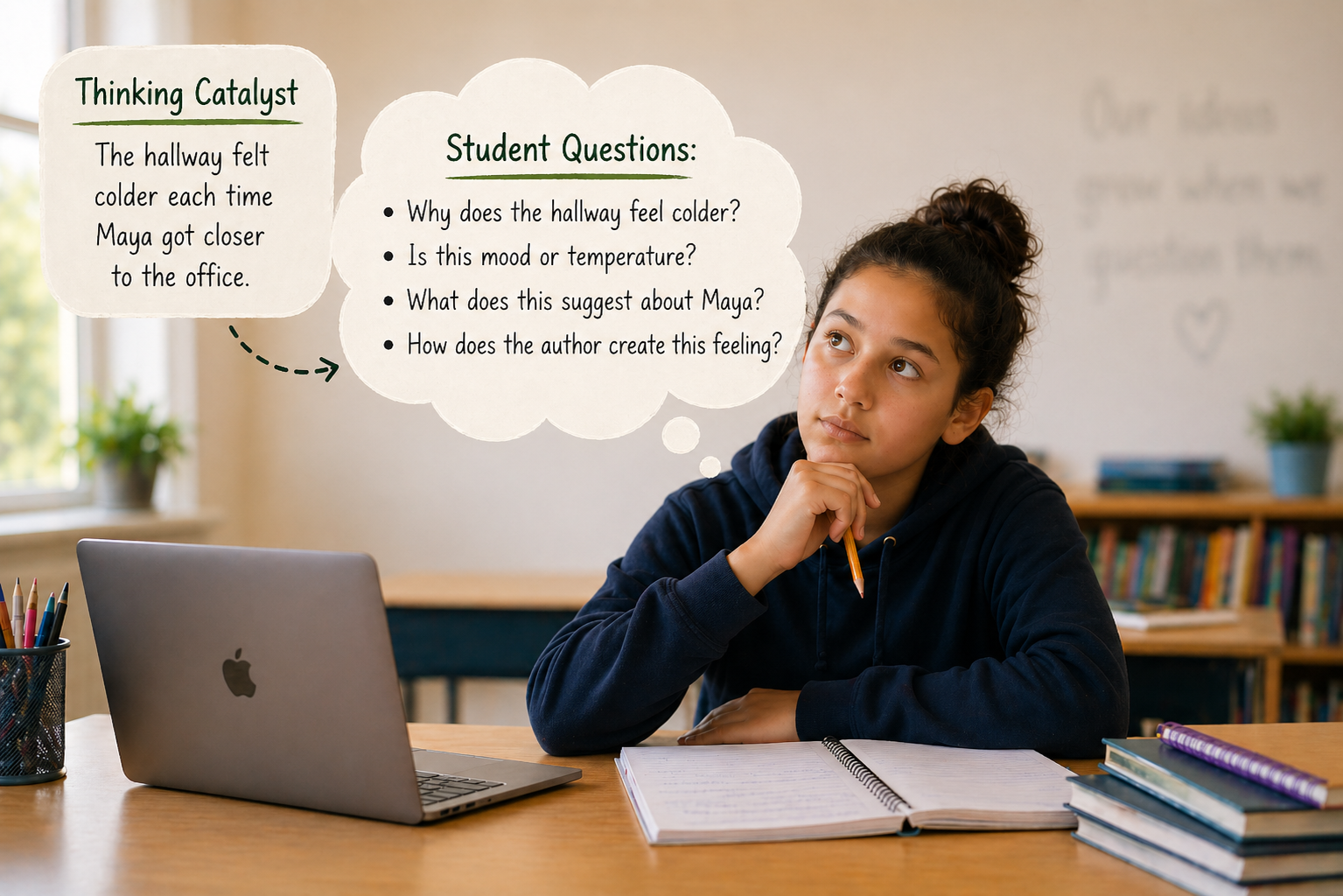
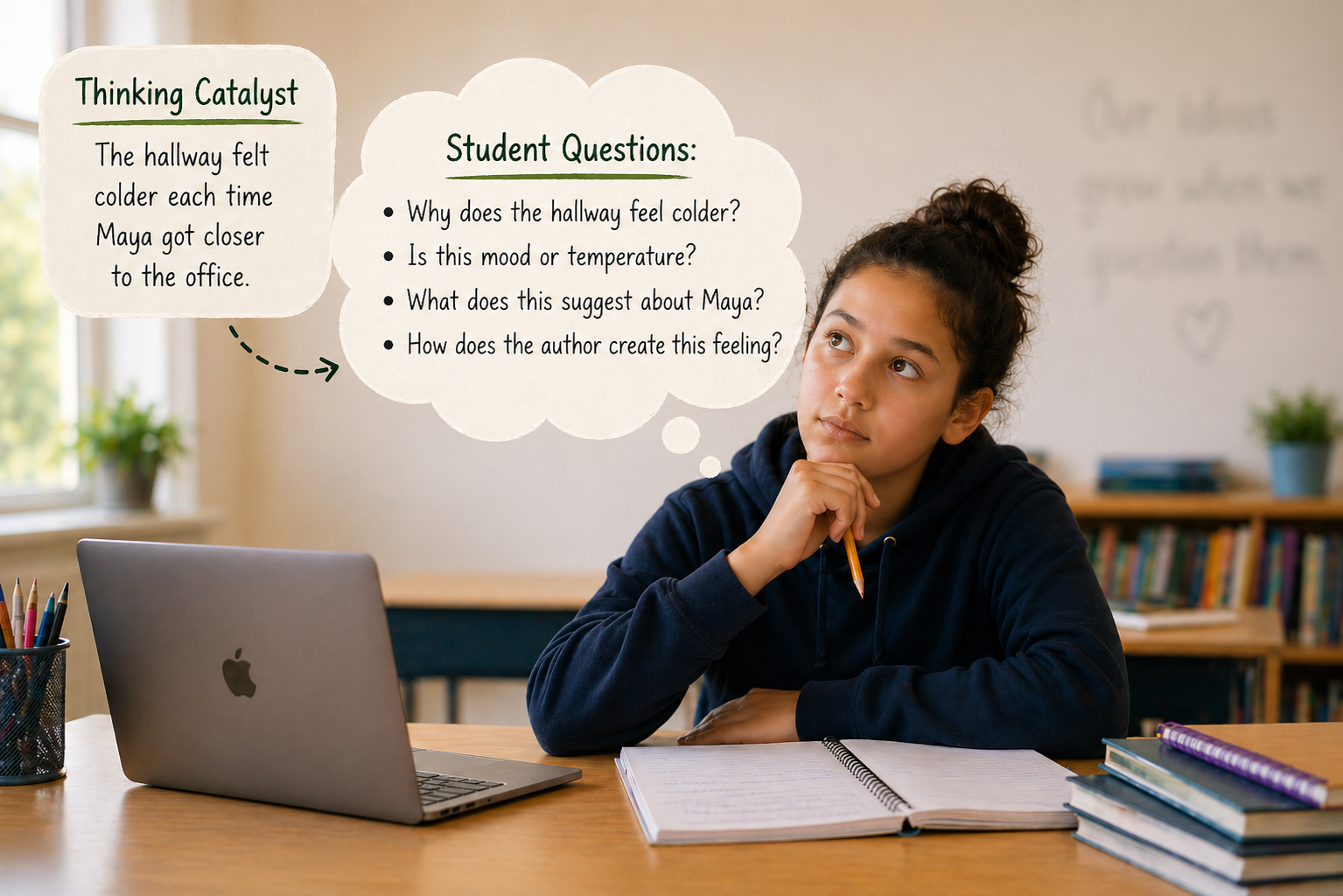
Instead of starting with completion, we can create space for students to engage with the material first. That might come from a line in a text, an image, or a problem that asks them to pause and think.
From there, students can generate their own questions and return to them as the work develops. Even a small shift like this can help teachers see how students are making sense of the work, not just what appears at the end.
Moving Forward
I do not think the future of education will be defined by whether students can generate answers quickly.
They already can.
The more important question is what students learn to do before and after those answers appear. Students still need practice slowing down with an idea, asking stronger questions, connecting thinking to evidence, and recognizing when something still needs to be checked.
That is where our attention needs to go.
AI is not going away, and neither is our responsibility to help students think deeply. If anything, that responsibility is becoming more urgent.
This is the work I am building across my classroom, my writing, and the professional learning I am designing for educators. I am interested in AI, but I am even more interested in what AI is asking us to reconsider about learning itself.
Because in the age of AI, the goal cannot simply be faster completion.
The goal has to be deeper thinking.
Let’s stay connected:
Despite the Rain, They Came
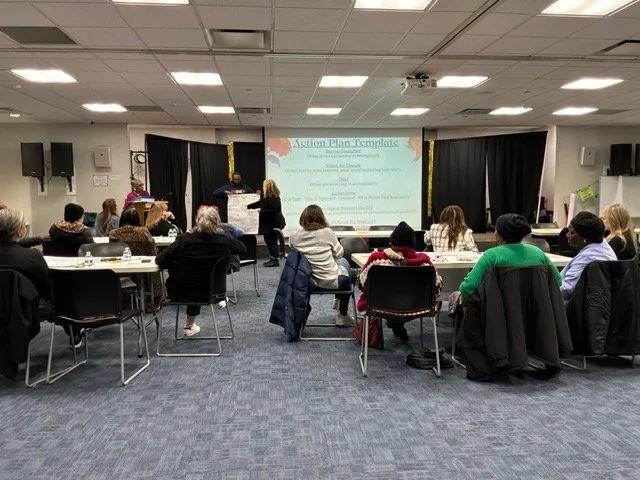
The room was filled with voices that mattered.
On the morning of Monday, March 16, 2026, the rain was relentless. It poured, let up for a moment, and then came down even harder. As I watched the weather, one thought kept running through my mind: Will people still come?
My co-chairs and I worked hard to plan a community forum for the district equity committee, focused on equity and belonging. With the support of our superintendent and district leadership, this was not just another event on the calendar. It was something we believed in deeply. As the rain continued to fall, I couldn’t help but wonder if all of that work would lead to an empty room.
But what stayed with me even more than the weather was who showed up.
The people who walked through those doors that evening are individuals I hold close to my heart. Many of them have been serving this community for decades, showing up for children, for families, and for Long Beach in ways that often go unseen. They represent commitment. They represent care. They represent what it truly means to invest in a community.
And despite the rain, they came.
Not just to attend, but to engage.
That evening, we came together to continue a conversation that began the previous year, one centered on belonging. We revisited barriers around communication, partnerships, diversity, and student access, but this time something felt different.
It wasn’t just about naming challenges.
It was about ownership.
There was a shared understanding in the room that this work belongs to all of us.
What made the evening even more meaningful was the presence of both district and city leadership, including our superintendent and city manager, alongside school leaders who did not just attend, but sat, listened, and participated in the conversations. There was no hierarchy in those moments. Just people gathered around tables, speaking honestly and listening with intention.
As I sat in that space, I kept thinking about how often we talk about creating belonging for students.
But belonging does not start with students.
It starts with us.
It starts with whether we are willing to listen, not to respond, but to understand. It starts with whether we create spaces where voices are not just invited, but truly valued.
That night reminded me that meaningful change does not happen through one meeting or one plan.
It happens when people show up, again and again, with honesty, with care, and with a shared belief that things can be better.
And despite the rain, they did.
Moments like this don’t happen by accident. They are designed.


I See Them From Afar
I See Them From Afar
By Natasha Nurse / February 23, 2026
I remember watching the moment unfold as a player from our community celebrated a goal with his hockey team on the Olympic stage. It felt like more than a highlight. I kept thinking about what moments like this mean for young people growing up in our community and how powerful it is when someone sees possibility in them early. Scenes like this reach far beyond the hockey rink. They echo into classrooms and the quiet moments where students are still figuring out what they can become.
Recently, our community celebrated a powerful moment. A Long Beach native stood on an Olympic podium with a gold medal around his neck after years of quiet work and persistence. As I watched, I thought about the students sitting in classrooms just blocks away from where that journey began. I found myself wondering what our students believe is possible for themselves and who might already be walking among us, still unseen.
Community has always shaped how I see my work. The students I teach are not distant from me. They are part of the same spaces that raised me and continue to surround me. That closeness carries responsibility, but it also carries hope. Each day I am reminded that extraordinary paths can begin in familiar places. Possibility often grows quietly long before anyone notices.
From the first day of school, I tell my students something simple but deeply true. I see them from afar. Not only as they are today, but as who they are becoming. I do what I do because of what I believe is possible for them, even when they cannot yet see it themselves.
I notice the quiet thinker. I notice the hesitant voice. I watch the student who is still searching for confidence.
Teaching has never been only about content for me. It has been about belief. I hold a vision of students that goes beyond assignments and grades. Long before they step into future roles, there is a period when belief must be borrowed. Sometimes that belief comes from a teacher.
Students may not remember every lesson, but they remember how they felt in spaces where they were seen. They remember who spoke possibility into them. When classrooms make room for thinking and voice, something begins to shift. Students start to believe they are capable of more than completing work. They begin to see themselves as thinkers and contributors whose presence matters.
If we want belief to live in our classrooms, it has to show up in small moments. Not in big speeches or perfectly planned lessons, but in how we show up while students are still finding their footing. Sometimes that looks like a brief conversation in the hallway or a quiet check-in that lets a student know they matter.
Action steps teachers can try this week:
Name one strength out loud.
Choose one student each day. Say what you see. Keep it simple and true.
Make room for student thinking.
Ask one question that has more than one possible answer. Let students talk before you teach.
Treat mistakes like information.
When a student gets it wrong, try “Tell me what you were thinking” before you correct.
Offer belief before results show up.
Say “I’m not giving up on you” or “I can see you figuring this out” even when the work is messy.
Have one small check-in.
A quick “How are you today?” or “You good?” can be the moment a student remembers.
The Olympic moment reminded me that extraordinary paths often begin in ordinary places. In quiet moments that seem small at the time, belief is taking root. If students leave our classrooms with even a small sense that they are capable and worthy, then something lasting has happened. Long before they arrive at who they will become, someone must see them from afar.

By Natasha Nurse / February 23, 2026
I remember watching the moment unfold as a player from our community celebrated a goal with his hockey team on the Milano Cortina 2026 Olympic stage. It felt like more than a highlight. I kept thinking about what moments like this mean for young people growing up in our community and how powerful it is when someone sees possibility in them early. Scenes like this reach far beyond the hockey rink. They echo into classrooms and the quiet moments where students are still figuring out what they can become.
That medal did not just represent victory. It represented years of persistence that began in the same neighborhoods where young people now sit in classrooms just blocks away. As I watched, I wondered what our students imagine for themselves and whether someone already among us is still waiting to be seen.
I could not watch it without thinking about my own students.
Community has always shaped how I see my work. The students I teach are not distant from me. They are part of the same spaces that raised me and continue to surround me. That closeness carries responsibility, but it also carries hope. Each day I am reminded that extraordinary paths can begin in familiar places. Possibility often grows quietly long before anyone notices.
From the first day of school, I tell my students something simple but deeply true. I see them from afar. Not only as they are today, but as who they are becoming. I do what I do because of what I believe is possible for them, even when they cannot yet see it themselves.
I notice the quiet thinker. I notice the hesitant voice. I watch the student who is still searching for confidence.
Teaching has never been only about content for me. It has been about belief. I hold a vision of students that goes beyond assignments and grades. Long before they step into future roles, there is a period when belief must be borrowed. Sometimes that belief comes from a teacher.
Students may not remember every lesson, but they remember how they felt in spaces where they were seen. They remember who spoke possibility into them. When classrooms make room for thinking and voice, something begins to shift. Students start to believe they are capable of more than completing work. They begin to see themselves as thinkers and contributors whose presence matters.
If we want belief to live in our classrooms, it has to show up in small moments. Not in big speeches or perfectly planned lessons, but in how we show up while students are still finding their footing. Sometimes that looks like a brief conversation in the hallway or a quiet check-in that lets a student know they matter.
Small moves that make belief visible:
Name one strength out loud.
Choose one student each day. Say what you see. Keep it simple and true.
Make room for student thinking.
Ask one question that has more than one possible answer. Let students talk before you teach.
Treat mistakes like information.
When a student gets it wrong, try “Tell me what you were thinking” before you correct.
Offer belief before results show up.
Say “I’m not giving up on you” or “I can see you figuring this out” even when the work is messy.
Have one small check-in.
A quick “How are you today?” or “You good?” can be the moment a student remembers.
The Olympic moment reminded me that extraordinary paths often begin in ordinary places. In quiet moments that seem small at the time, belief is taking root. If students leave our classrooms with even a small sense that they are capable and worthy, then something lasting has happened. Long before they arrive at who they will become, someone must see them from afar.
Designing for Thinking, Not Just Instruction

By Natasha Nurse / January 22, 2026
I did not begin my career thinking about systems or long-term design. I began in the classroom. And early on, I noticed something I could not yet explain.
Some lessons looked strong on paper. The objectives were clear. The activities were engaging. Students followed directions and completed their work. Yet when the lesson ended, the learning felt fleeting. Students had done what was asked, but the thinking did not stay with them. At the time, I did not have language for what I was noticing. I only knew that learning should feel more lasting than this.
When Learning Looks Fine but Feels Thin
Like most teachers, I worked hard. I planned carefully and spent a lot of time thinking about how to make learning engaging. When learning felt shallow, my instinct was to add something. Another activity. More structure. I assumed that if students were not engaging deeply, the answer was to do more.
Over time, I realized the issue was not effort or creativity.
It was coherence.
Strong instruction is not defined by individual lessons or tools. It is shaped by how learning experiences connect over time. When students understand why they are doing what they are doing, and when ideas build in ways that make sense, learning feels anchored. When experiences feel disconnected, students may comply, but thinking fades.
The Problem Was Not Effort. It Was Coherence.
What became clear to me was this. Students were not struggling because they lacked ability. They struggled when the purpose of learning was unclear.
When learning experiences unfolded without a clear throughline, students focused on completion. The work got done, but ideas did not deepen. Over time, this can create classrooms where progress is measured by pace rather than understanding.
When learning experiences were designed with coherence in mind, something shifted. Students stayed with ideas longer. Their questions changed. They were more willing to revisit their thinking and make sense of what they were learning.
That shift did not come from lowering expectations. It came from intentional design.
Thinking Is Not Extra. It Is the Work.
One of the most important lessons I have learned over time is this. Thinking is not something students do after the lesson. Thinking is the lesson.
When instruction prioritizes movement over meaning, thinking quietly slips into the background. Students learn to look for answers rather than engage with ideas. Completion becomes the goal, even when understanding has not fully formed.
That is not a student issue. It is a design issue.
Over time, this understanding shaped how I approached my work. I paid closer attention to how ideas connected across lessons and units and to where students needed more space to think and reflect. Learning began to feel more purposeful, both for students and for me.
What I Noticed Beyond My Own Classroom.
As my work expanded beyond my own classroom into interdisciplinary curriculum design and collaboration with other educators, this belief stayed with me. Again and again, I noticed the same pattern.
When learning experiences were coherent, students engaged in deeper thinking. When learning felt fragmented, students focused on getting through tasks. Design, not motivation, was the difference.
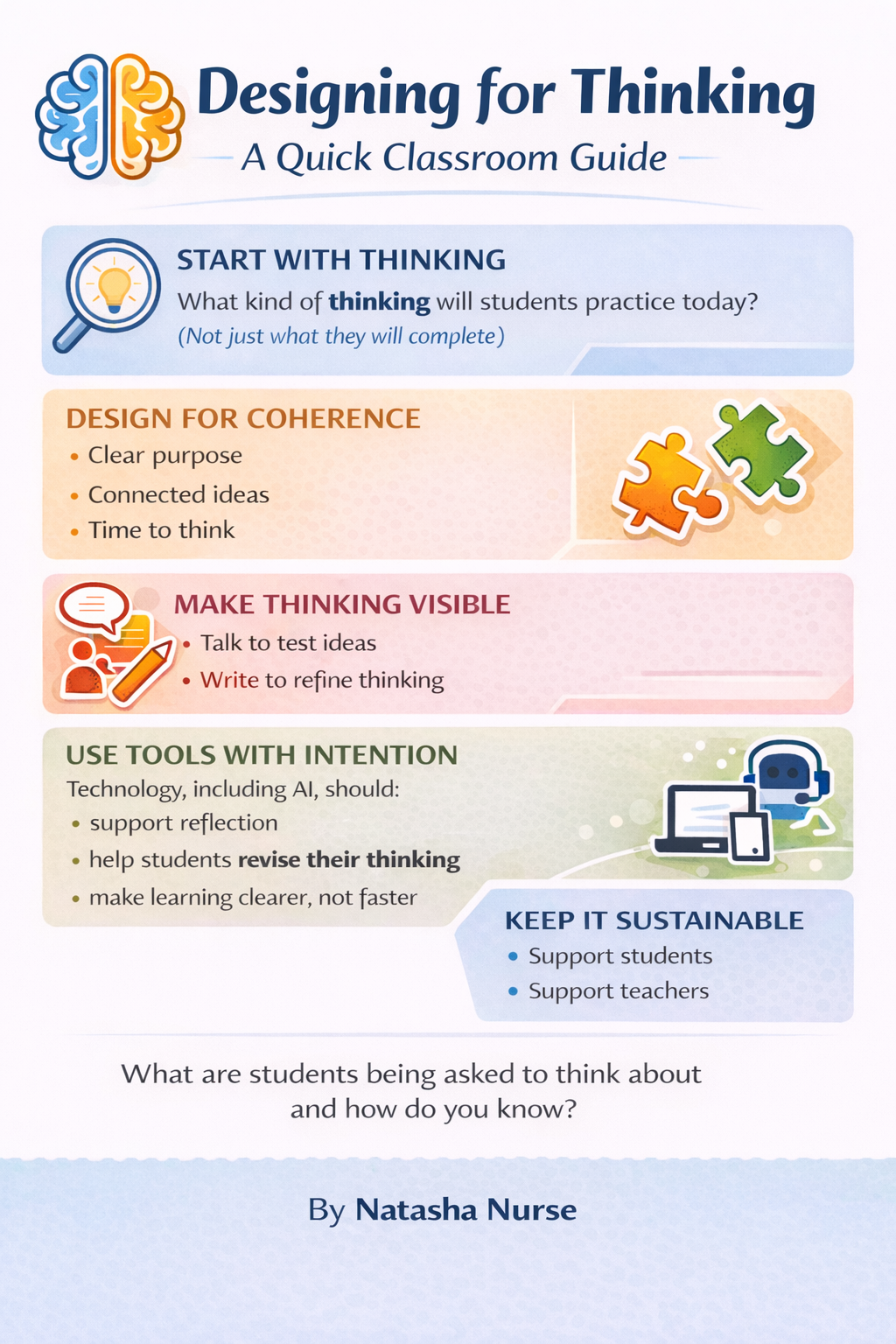
To keep myself grounded in this work, I return to a simple question that guides my planning and my conversations with educators.
What kind of thinking are students being invited to do?
That question led me to create a visual guide I now share to help keep instruction anchored in thinking rather than completion. You will find it at the end of this post.
It is not a checklist. It is a way of noticing. It helps surface how ideas connect and whether students have the time and space to think clearly about their learning. When instruction is designed with coherence, thinking becomes visible and sustainable.
Why I Am Sharing This Now
I am still a classroom teacher, and that matters to me. Being in the classroom keeps my work grounded in students and in the day-to-day realities of learning. What I write about has been shaped by years of teaching, including students I have taught, moments of reflection in the classroom, and experiences that have continued to refine my approach.
Over the years, I have returned to those moments again and again. My doctoral work has given me the space to step back and examine patterns in learning design that I had been noticing throughout my career. It has allowed me to look more closely at why certain conditions consistently support student thinking and engagement over time. That work does not replace classroom experience. It strengthens it. It gives language to professional instincts shaped over many years and helps me articulate what I have seen work, what does not, and why.
This is where my thinking lives now.
Instruction matters. But thinking matters more.
And the question that continues to ground my work is this:
What are students being asked to think about, and how do we know?