I See Them From Afar
I See Them From Afar
By Natasha Nurse / February 23, 2026
I remember watching the moment unfold as a player from our community celebrated a goal with his hockey team on the Olympic stage. It felt like more than a highlight. I kept thinking about what moments like this mean for young people growing up in our community and how powerful it is when someone sees possibility in them early. Scenes like this reach far beyond the hockey rink. They echo into classrooms and the quiet moments where students are still figuring out what they can become.
Recently, our community celebrated a powerful moment. A Long Beach native stood on an Olympic podium with a gold medal around his neck after years of quiet work and persistence. As I watched, I thought about the students sitting in classrooms just blocks away from where that journey began. I found myself wondering what our students believe is possible for themselves and who might already be walking among us, still unseen.
Community has always shaped how I see my work. The students I teach are not distant from me. They are part of the same spaces that raised me and continue to surround me. That closeness carries responsibility, but it also carries hope. Each day I am reminded that extraordinary paths can begin in familiar places. Possibility often grows quietly long before anyone notices.
From the first day of school, I tell my students something simple but deeply true. I see them from afar. Not only as they are today, but as who they are becoming. I do what I do because of what I believe is possible for them, even when they cannot yet see it themselves.
I notice the quiet thinker. I notice the hesitant voice. I watch the student who is still searching for confidence.
Teaching has never been only about content for me. It has been about belief. I hold a vision of students that goes beyond assignments and grades. Long before they step into future roles, there is a period when belief must be borrowed. Sometimes that belief comes from a teacher.
Students may not remember every lesson, but they remember how they felt in spaces where they were seen. They remember who spoke possibility into them. When classrooms make room for thinking and voice, something begins to shift. Students start to believe they are capable of more than completing work. They begin to see themselves as thinkers and contributors whose presence matters.
If we want belief to live in our classrooms, it has to show up in small moments. Not in big speeches or perfectly planned lessons, but in how we show up while students are still finding their footing. Sometimes that looks like a brief conversation in the hallway or a quiet check-in that lets a student know they matter.
Action steps teachers can try this week:
Name one strength out loud.
Choose one student each day. Say what you see. Keep it simple and true.
Make room for student thinking.
Ask one question that has more than one possible answer. Let students talk before you teach.
Treat mistakes like information.
When a student gets it wrong, try “Tell me what you were thinking” before you correct.
Offer belief before results show up.
Say “I’m not giving up on you” or “I can see you figuring this out” even when the work is messy.
Have one small check-in.
A quick “How are you today?” or “You good?” can be the moment a student remembers.
The Olympic moment reminded me that extraordinary paths often begin in ordinary places. In quiet moments that seem small at the time, belief is taking root. If students leave our classrooms with even a small sense that they are capable and worthy, then something lasting has happened. Long before they arrive at who they will become, someone must see them from afar.

By Natasha Nurse / February 23, 2026
I remember watching the moment unfold as a player from our community celebrated a goal with his hockey team on the Milano Cortina 2026 Olympic stage. It felt like more than a highlight. I kept thinking about what moments like this mean for young people growing up in our community and how powerful it is when someone sees possibility in them early. Scenes like this reach far beyond the hockey rink. They echo into classrooms and the quiet moments where students are still figuring out what they can become.
That medal did not just represent victory. It represented years of persistence that began in the same neighborhoods where young people now sit in classrooms just blocks away. As I watched, I wondered what our students imagine for themselves and whether someone already among us is still waiting to be seen.
I could not watch it without thinking about my own students.
Community has always shaped how I see my work. The students I teach are not distant from me. They are part of the same spaces that raised me and continue to surround me. That closeness carries responsibility, but it also carries hope. Each day I am reminded that extraordinary paths can begin in familiar places. Possibility often grows quietly long before anyone notices.
From the first day of school, I tell my students something simple but deeply true. I see them from afar. Not only as they are today, but as who they are becoming. I do what I do because of what I believe is possible for them, even when they cannot yet see it themselves.
I notice the quiet thinker. I notice the hesitant voice. I watch the student who is still searching for confidence.
Teaching has never been only about content for me. It has been about belief. I hold a vision of students that goes beyond assignments and grades. Long before they step into future roles, there is a period when belief must be borrowed. Sometimes that belief comes from a teacher.
Students may not remember every lesson, but they remember how they felt in spaces where they were seen. They remember who spoke possibility into them. When classrooms make room for thinking and voice, something begins to shift. Students start to believe they are capable of more than completing work. They begin to see themselves as thinkers and contributors whose presence matters.
If we want belief to live in our classrooms, it has to show up in small moments. Not in big speeches or perfectly planned lessons, but in how we show up while students are still finding their footing. Sometimes that looks like a brief conversation in the hallway or a quiet check-in that lets a student know they matter.
Small moves that make belief visible:
Name one strength out loud.
Choose one student each day. Say what you see. Keep it simple and true.
Make room for student thinking.
Ask one question that has more than one possible answer. Let students talk before you teach.
Treat mistakes like information.
When a student gets it wrong, try “Tell me what you were thinking” before you correct.
Offer belief before results show up.
Say “I’m not giving up on you” or “I can see you figuring this out” even when the work is messy.
Have one small check-in.
A quick “How are you today?” or “You good?” can be the moment a student remembers.
The Olympic moment reminded me that extraordinary paths often begin in ordinary places. In quiet moments that seem small at the time, belief is taking root. If students leave our classrooms with even a small sense that they are capable and worthy, then something lasting has happened. Long before they arrive at who they will become, someone must see them from afar.
Designing for Thinking, Not Just Instruction

By Natasha Nurse / January 22, 2026
I did not begin my career thinking about systems or long-term design. I began in the classroom. And early on, I noticed something I could not yet explain.
Some lessons looked strong on paper. The objectives were clear. The activities were engaging. Students followed directions and completed their work. Yet when the lesson ended, the learning felt fleeting. Students had done what was asked, but the thinking did not stay with them. At the time, I did not have language for what I was noticing. I only knew that learning should feel more lasting than this.
When Learning Looks Fine but Feels Thin
Like most teachers, I worked hard. I planned carefully and spent a lot of time thinking about how to make learning engaging. When learning felt shallow, my instinct was to add something. Another activity. More structure. I assumed that if students were not engaging deeply, the answer was to do more.
Over time, I realized the issue was not effort or creativity.
It was coherence.
Strong instruction is not defined by individual lessons or tools. It is shaped by how learning experiences connect over time. When students understand why they are doing what they are doing, and when ideas build in ways that make sense, learning feels anchored. When experiences feel disconnected, students may comply, but thinking fades.
The Problem Was Not Effort. It Was Coherence.
What became clear to me was this. Students were not struggling because they lacked ability. They struggled when the purpose of learning was unclear.
When learning experiences unfolded without a clear throughline, students focused on completion. The work got done, but ideas did not deepen. Over time, this can create classrooms where progress is measured by pace rather than understanding.
When learning experiences were designed with coherence in mind, something shifted. Students stayed with ideas longer. Their questions changed. They were more willing to revisit their thinking and make sense of what they were learning.
That shift did not come from lowering expectations. It came from intentional design.
Thinking Is Not Extra. It Is the Work.
One of the most important lessons I have learned over time is this. Thinking is not something students do after the lesson. Thinking is the lesson.
When instruction prioritizes movement over meaning, thinking quietly slips into the background. Students learn to look for answers rather than engage with ideas. Completion becomes the goal, even when understanding has not fully formed.
That is not a student issue. It is a design issue.
Over time, this understanding shaped how I approached my work. I paid closer attention to how ideas connected across lessons and units and to where students needed more space to think and reflect. Learning began to feel more purposeful, both for students and for me.
What I Noticed Beyond My Own Classroom.
As my work expanded beyond my own classroom into interdisciplinary curriculum design and collaboration with other educators, this belief stayed with me. Again and again, I noticed the same pattern.
When learning experiences were coherent, students engaged in deeper thinking. When learning felt fragmented, students focused on getting through tasks. Design, not motivation, was the difference.
To keep myself grounded in this work, I return to a simple question that guides my planning and my conversations with educators.
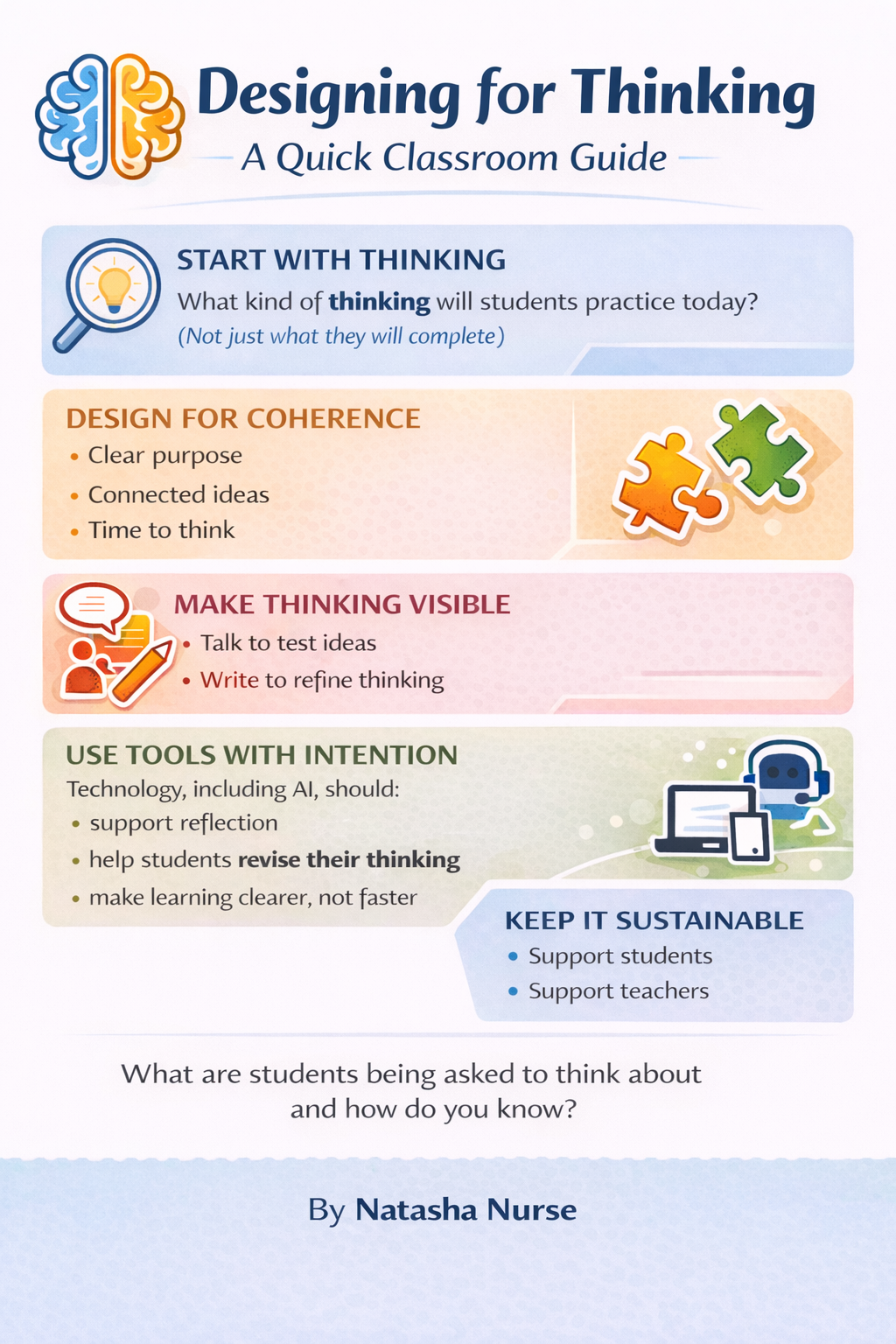
What kind of thinking are students being invited to do?
That question led me to create a visual guide I now share to help keep instruction anchored in thinking rather than completion. You will find it at the end of this post.
It is not a checklist. It is a way of noticing. It helps surface how ideas connect and whether students have the time and space to think clearly about their learning. When instruction is designed with coherence, thinking becomes visible and sustainable.
Why I Am Sharing This Now
I am still a classroom teacher, and that matters to me. Being in the classroom keeps my work grounded in students and in the day-to-day realities of learning. What I write about has been shaped by years of teaching, including students I have taught, moments of reflection in the classroom, and experiences that have continued to refine my approach.
Over the years, I have returned to those moments again and again. My doctoral work has given me the space to step back and examine patterns in learning design that I had been noticing throughout my career. It has allowed me to look more closely at why certain conditions consistently support student thinking and engagement over time. That work does not replace classroom experience. It strengthens it. It gives language to professional instincts shaped over many years and helps me articulate what I have seen work, what does not, and why.
This is where my thinking lives now.
Instruction matters. But thinking matters more.
And the question that continues to ground my work is this:
What are students being asked to think about, and how do we know?